Jewish Attempts at Sovereignty Have Always Ended in Catastrophe
Advocates for Zionism habitually claim that the Jewish yearning to return to sovereignty in the land of Israel has always been intrinsic to Judaism. Examples of this claim abound - here's the ADL’s Jonathan Greenblatt making it last year, in an interview with the New York Times:
Zionism is essential to the Jewish tradition. The idea of Jews returning to Israel, we’ve been talking about it since Moses, literally. Political Zionism is newer, 125 years, but that notion of self-determination in the homeland doesn’t exclude Palestinians, doesn’t exclude any other group. It’s saying Jews have the right, this sort of liberation movement, to go back to where they’re from.
It's a common and oft-repeated Zionist trope. It's also categorically false. The very opposite is true, in fact. Until the onset of Zionist ideology in the 19th century, Jewish sovereignty in the land was viewed as an anathema by Judaism for a very simple reason: historical moments of Jewish political independence have consistently resulted in catastrophe and ruin for the Jewish people. These moments are worth unpacking, not least to consider the ways they've been framed by Jewish spiritual memory. It’s also instructive to examine how these disastrous attempts at Jewish sovereignty have been rehabilitated and glorified by Zionist ideology.
Historically speaking, there were four such examples: the Biblical Kingship, the Hasmonean Kingdom, the Great Revolt and the Bar Kochba Rebellion. Though each period was relatively brief, their legacies loom large in Jewish history and Jewish spiritual tradition.
Let’s look at each in turn:
The Biblical Kingship
While Classical Zionism idealizes the ancient Israelite Kingdom as described in the Hebrew Bible, it’s critical to note that the Bible is not a history book - and there is no scholarly consensus over the historiography of the events related in the Biblical narrative. We do know, however, that the Biblical narrative itself is deeply ambivalent about the establishment of the Israelite kingship.
In the first book of Samuel, the Israelites, weary of wars with the surrounding nations, approach the prophet Samuel and declare, “give us a king to govern us like all other nations.” Samuel is deeply grieved, taking their demand as a personal failure of his prophetic leadership. He relays their request to God, who tells him, “Heed the demand of the people in everything they say to you. For it is not you that they have rejected; it is Me they have rejected to rule over them.” (l Samuel 8:7)
The desire to “be like all the other nations” is, in fact, a central Zionist dictum, dating back to Theodor Herzl, who argued that the Jews would only be normalized as a people if they were constituted as a modern nation state. In the Hebrew Bible, however, the yearning to be a nation like other nations is regarded as a rejection of God as the Israelites’ Sovereign. The Biblical land tradition did not glorify sovereign rule - rather, the land was idealized as a place where the people could observe God’s commandments and serve as a “holy nation.” (Exodus 19:6) Throughout the Bible, the Israelites are repeatedly warned that their future on the land is not guaranteed - that transgressing God’s commandments and lapsing into idolatry would result in dispossession and exile.
In the end, this is precisely what happens. The Israelite Kingdom eventually descended into corruption and factionalization. In 930 BCE the kingship split into separately governed Northern and Southern Kingdoms. The Northern Kingdom fell to Assyria in 722 BCE, and the Southern Kingdom was conquered by Babylonia in 586 BCE. In all, the Biblical Kingdom lasted 400 years. The fall of Jerusalem to Babylon, vividly and horrifically rendered in the books of Jeremiah and Lamentations, is considered to be a paradigmatic Jewish tragedy by Jewish tradition to this very day.
The Hasmonean Kingdom
There was a brief, ill-fated return to Jewish sovereignty in 142 BCE when the Hasmonean Kingdom gained independence following the Maccabean revolt against Seleucid ruler Antiochus IV. Though the rebellion - later connected to the festival of Hanukkah - is characterized by Zionist mythology as a heroic nationalistic uprising against religious tyranny, the Hasmonean Kingdom actually emerged following a divisive and bloody Jewish civil war.
Following the death of Alexander the Great (who conquered the region from the Persians in 332 BCE), his empire split into the Seleucid Kingdom in the north and the Ptolemaic Kingdom to the south. During this period, the Jewish community became increasingly factionalized between pro-Seleucid and pro-Ptolemaic parties. After the Seleucids wrested control of Judea from the Ptolemites in 200 BCE, these divisions increased, with some factions supporting integration into Hellenistic culture and others doubling down on traditional Jewish practice. This factionalization eventually descended into an all-out intra-Jewish war. When Antiochus asserted control by seizing the Temple in Jerusalem and outlawing public displays of Jewish religion, the priestly house of Mattathias (known as the Maccabees) led a successful revolt against the Seleucid rule and their Jewish Hellenistic supporters.
It’s fair to say that the Hasmonean period of Jewish sovereignty in the land was a short and ignoble era in Jewish history: a 100-year period of increasing sectarianism, political corruption and the waging of ill-advised foreign wars in the region. While the Hasmoneans were at first allies of the Romans, they eventually became a client state of the empire - and in the end, the Roman military overthrew the Hasmonean Kingdom in 63 BCE. The general Pompey leveled Jerusalem's walls, stripped royal power from Hasmonean leaders, and subjected the region to Roman domination. The Jewish population became vassals of Rome, subject to heavy taxation and political instability.
For their part, the rabbis of the Talmud were loath to glorify the Books of the Maccabees – secular stories that were never actually canonized as part of the Hebrew Bible. The rabbis played down the military escapades of the Maccabees and the brief period of Jewish independence under Hasmonean Kingdom. In fact, the festival of Hanukkah is scarcely mentioned in the Talmud beyond a brief debate about how to light the Hanukkah menorah and a legend about a miraculous vial of oil that burned for eight days. Notably, the rabbis chose the words of Zechariah 4:6, Not by might and not by power, but by my spirit, says the Lord of Hosts to be recited as the prophetic portion for the festival.
Hanukkah remained a relatively minor Jewish festival until it was revived by early Zionists and the founders of the state of Israel, who fancied themselves as modern-day Maccabees engaged in their own military struggle for political independence. At the end of his book, The Jewish State, Zionist movement founder Theodor Herzl famously wrote, “The Maccabees will rise again!”
The Great Revolt
During Roman rule, tensions with the Jewish community began to rise in 64 CE under the increasingly heavy-handed, oppressive behavior of the governor Gessius Florus. Jewish factions eventually organized rebellions, though some priests and Pharisees attempted to stem them, revolts eventually spread throughout the country. The rebels were not a unified group - many of the factions were messianic, most prominently the followers of Simeon bar Gioira, who committed acts of violence against Romans with other Jewish rebel factions.
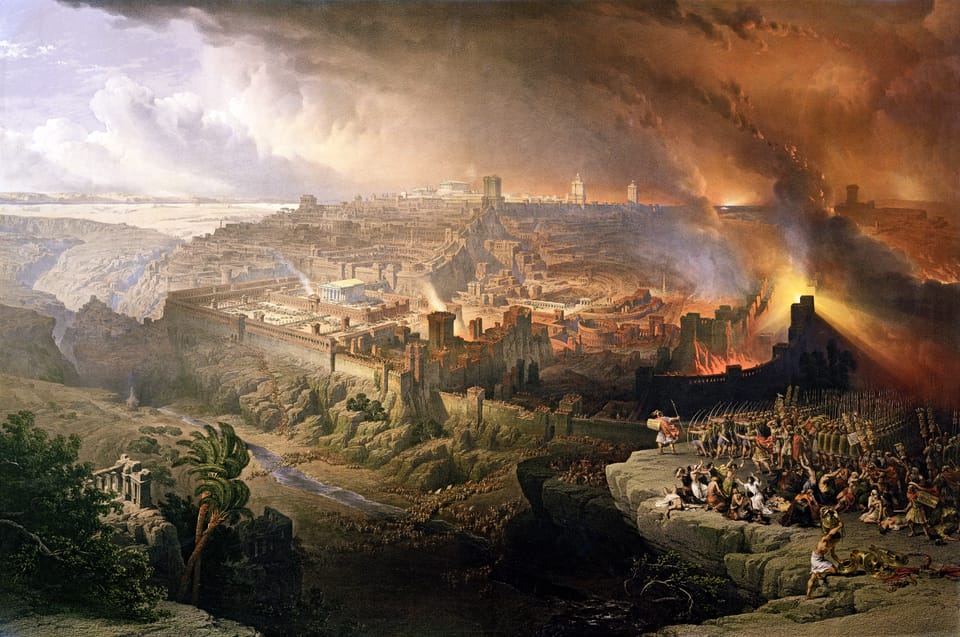
In 66 CE, Jerusalem was militarily seized by the rebels, who set up a provisional Jewish government. Although their intention was to create and govern a full Jewish state, the new government fell two years later, due to deep divisions among factions and weak authority over independent militias. Though various uprisings continued throughout the land, they were ultimately no match for the might of the Roman empire. The leaders of the Great Revolt retreated to Jerusalem, which was besieged by the Roman military commander Titus. In 70 CE, the Temple was destroyed and Roman forces razed the city. The fall of Jerusalem, was described in tragic detail by the Jewish historian in “The Jewish War:”
When (the Romans) went in numbers into the lanes of the city, with their swords drawn, they slew those whom they overtook, without mercy, and set fire to the houses wither the Jews were fled, and burnt every soul in them, and laid waste a great many of the rest; and when they were come to the houses to plunder them, they found in them entire families of dead men, and the upper rooms full of dead corpses, that is of such as died by the famine; they then stood in a horror at this sight, and went out without touching anything. But although they had this commiseration for such as were destroyed in that manner, yet had they not the same for those that were still alive, but they ran every one through whom they met with, and obstructed the very lanes with their dead bodies, and made the whole city run down with blood, to such a degree indeed that the fire of many of the houses was quenched with these men's blood. (from The Jewish War, Book 6, Chapter 5)
The destruction of the Temple had profound consequences for the Jewish people, who were killed, displaced and sold into slavery. The rabbinic sages, led by Rabbi Yochanan Ben Zakkai, emerged as leading figures and established a rabbinic center in Yavneh - a key moment in the development of Rabbinic Judaism as it adapted to this cataclysmic post-Temple reality.
The Bar Kochba Rebellion
Even amidst the tragic aftermath of the Great Revolt, resentment of Roman rule - and a desire for Jewish national sovereignty - remained strong throughout the Jewish community. In 130 CE, when the Emperor Hadrian announced plans to rebuild Jerusalem as Aelia Capitolina, hopes were dashed for those who sought a restoration of the Temple in Jerusalem. Hadrian’s draconian measures sparked a guerrilla war, led by Simon bar Kosiba, popularly known as Bar Kochba (“Son of the Star”).
As with previous revolts, there was a strong element of messianism in this nationalist revival. Bar Kochba was widely regarded as a messianic figure and was supported by prominent rabbis, most notably Rabbi Akiba. Others, like Rabbi Yochanan, strongly criticized him, referring to him derisively as “Bar Koziba” (literally, “Son of the Lie”).
The Bar Kochba rebellion broke out in 132 CE and eventually succeeded in establishing an independent Jewish state that lasted for over three years. Archaeological discoveries indicate that coins were struck with Jewish symbols and Hebrew inscriptions. There are also some indications that work was begun on rebuilding the Temple in Jerusalem, led by the high priest, Eleazar. Inevitably, however, the Roman Empire would respond to the Bar Kochba rebellion with the full force of its military might.
In 135 CE, Bar Kochba and his leadership retreated to its headquarters Betar, in the Judean Hills. After a three-and-a-half-year siege, Betar fell to the Romans, who then prosecuted a brutal military campaign that had catastrophic consequences for the Jewish community. The scale of devastation surpassed that of the Great War; some scholars surmise that two thirds of Judea’s population died in the revolt. The surviving Jews were expelled from Jerusalem, deported and enslaved. Hadrian publicly executed the leaders of the rebellion along with its rabbinic supporters, including Rabbi Akiba.
In the aftermath of this catastrophic event, the rabbis criticized Bar Kochba, for his nationalist hubris, his overt militarism and messianic pretensions. The fall of Betar and its tragic aftermath was commemorated on the annual fast day of Tisha B’Av, along with the destruction of the 1st and 2nd Temple as day of collective Jewish mourning.
Zionist mythology, however, rehabilitated Bar Kochba as a Jewish nationalist hero. Many Zionist leaders - including Max Nordau in his concept of "Muscular Judaism" - contrasted Bar Kochba's armed defiance with stereotypes of passive life in the Diaspora. Betar was transformed from a place of military defeat that resulted in the devastation of the Jewish community to a noble site of a nationalist “last stand.” Revisionist Zionists in particular have embraced the image of Betar, using the name for their youth movement (which exists to this day).
In response to these catastrophic attempts at Jewish sovereignty, the rabbinic sages framed the idea of return in future messianic terms, i.e., that the coming of the Messiah would presage a collective Jewish return to the land. In the meantime, however, they cautioned strongly against forcing God’s hand by giving any credence or support to false human messiahs who advocated the reestablishment of another sovereign Jewish state.
As we consider these historical examples, it's hard to miss the ominous parallels to the current moment: the rise of messianism, the increasing factionalization, the corruption, the reliance on militarism and the fatal embrace of empire. I believe this historical perspective is utterly critical and not simply academic. Each of these moments were just that: brief, temporary moments in history that constitute a collective warning that resonates more powerfully every day.
No, Jewish sovereignty is not intrinsic to Judaism, quite the contrary. As Jewish tradition has repeatedly taught, there is a transcendent Power far that far exceeds mere state power. As the state of Israel approaches its 80th year, we would do well to learn from this sacred vision – and to heed its crucial lessons.
Member discussion